
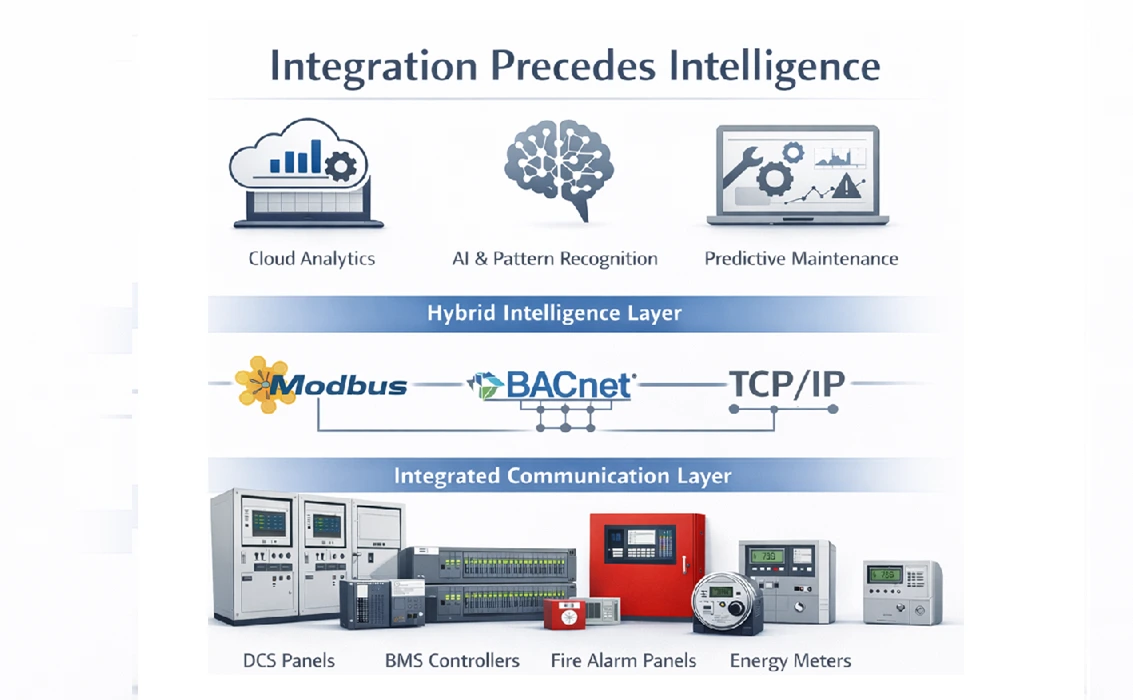
Modern facilities depend on control systems that were originally designed to ensure operational stability, safety, and supervisory visibility. Distributed Control Systems (DCS) govern industrial processes. Building Management Systems (BMS) regulate mechanical and environmental performance. Fire alarm panels, energy monitoring platforms, and security systems operate alongside them, each fulfilling its own defined function.
Individually, these systems perform reliably. Collectively, however, they often lack contextual coordination. The challenge facing today’s facilities is not the absence of monitoring — it is the absence of structured intelligence across domains.
Over the past decades, projects delivered in industrial ports, research laboratories, and complex technical environments have demonstrated that the foundation for intelligent infrastructure begins with disciplined integration.
🔹 Jubail – Security & Fire Integration into DCS
At the Royal Commission’s 5 Berths Project in Jubail, Saudi Arabia, industrial-grade SIL2 explosion-proof fire alarm systems were supplied and commissioned within a high-risk petrochemical environment.
Beyond compliance and safety performance, the critical element was the integration of fire and security systems into the Distributed Control System using Modbus protocol.
This achieved:
• Real-time alarm synchronization • Cross-domain monitoring visibility • Coordinated operational control
The fire system was no longer a standalone safety layer — it became part of the industrial monitoring ecosystem.
This is a fundamental architectural principle:
When safety and operational systems communicate within DCS, infrastructure shifts from segmented monitoring to coordinated control.
🔹 NAMRU-3 – Wireless Energy & Security Integration
At the NAMRU-3 Research Unit in Egypt, IntelliScan wireless systems were deployed to enable distributed monitoring of energy and security systems across the facility.
This implementation allowed:
• Wireless energy monitoring • Security integration • Facility-wide data visibility • Centralized oversight
When energy management and security systems share a unified monitoring framework, facilities gain contextual awareness.
Energy anomalies can be interpreted alongside occupancy patterns. Security events can be correlated with operational conditions. Distributed monitoring becomes structured intelligence.
🔹 IDH Mega Lab & Elmokhtabar – BMS & LC Integration
In advanced laboratory environments such as IDH Mega Lab and Elmokhtabar Central Laboratory, integration extended across:
• Fire alarm systems • Light current networks • Data infrastructure • Fire fighting systems • Building Management Systems
Laboratories require strict environmental control and coordinated safety response.
By integrating BMS with safety and communication systems, the facility achieved centralized visibility and cross-system coordination — moving beyond isolated monitoring toward operational synchronization.
From Monitoring to Intelligence
These projects collectively illustrate a progression in infrastructure maturity. Facilities move from standalone system deployment, to protocol-based integration, and eventually toward coordinated operational frameworks.
Yet even with successful integration at the control and monitoring layers, most facilities remain event-driven. Alarms are triggered, operators respond, maintenance is scheduled, and reports are generated. The data exists, but its potential remains underutilised.
Facilities move from standalone systems → to protocol-based integration → to coordinated monitoring
Yet even integrated environments remain largely event-driven.
An alarm is triggered. An operator responds. Maintenance is scheduled.
The data exists — but it is not yet fully leveraged.
The next phase is hybrid intelligence.
The Hybrid Model
Hybrid infrastructure intelligence builds on three layers:
1️⃣ Edge & Control Layer DCS controllers, BMS panels, energy meters, fire and security systems.
2️⃣ Integration Layer Protocol-based communication (Modbus, BACnet, TCP/IP) and unified dashboards.
3️⃣ Intelligence Layer (Cloud + AI) Data aggregation Pattern recognition Anomaly detection Predictive maintenance modeling Automated workflow orchestration
This evolution does not replace DCS or BMS.
It extends their capabilities.
Instead of:
Alarm → Operator response
We move toward:
Signal → Pattern correlation → Predictive insight → Proactive action
Engineering Before AI
Artificial intelligence in infrastructure is only meaningful when the underlying architecture is disciplined.
Without structured integration:
• Data remains fragmented • Context is lost • Correlation is limited • Predictive modeling becomes unreliable
Projects such as Jubail, NAMRU-3, and IDH Mega Lab demonstrate that integration expertise provides the technical foundation upon which intelligent systems can operate.
Integration precedes intelligence.
Looking Forward
Across industrial ports, research laboratories, and technically demanding environments, one consistent principle emerges:
Infrastructure performs best when systems are connected.
As facilities evolve toward greater efficiency, sustainability, and predictive capability, the transition will not be from control to automation.
It will be from control to intelligence.
And that transition begins with structured integration.
The future of infrastructure will not be defined by isolated systems nor by superficial automation. It will be defined by connected architectures, layered intelligence, and disciplined engineering execution. From petrochemical berths to laboratory environments and energy-integrated facilities, the path forward lies in extending integration into intelligence — responsibly, systematically, and sustainably.
The next evolution lies in hybrid intelligence — not as a replacement for DCS or BMS, but as an extension of their capabilities.
#SmartInfrastructure #BMS #DCS #SystemsIntegration #FacilityManagement #IndustrialEngineering #HybridIntelligenceStart writing here...